Rocklin, CA · Garage Door Service
Emergency garage door repair for these Antelope, CA homes built mostly in the early 1990s. Rocklin Garage Door Pros covers this 9-mile route from Rocklin.
Rocklin Garage Door Pros runs its trucks out of Rocklin, and Antelope sits about 9 miles up the route - close enough that a call here usually slots into the same day's run without a separate trip fee. We won't promise you an exact arrival window over the phone, because drive time plus whatever's already on the board that day decides it, not us. What we will do is get you on the schedule the day you call, in the order calls come in.
If a spring snaps or a door won't move at all, say so when you call. That moves you ahead of routine service calls, which is the whole point of calling it emergency work instead of booking a slot next week.
For the areas this covers around Antelope, the coverage page lays it out. If you want the broader picture of what the emergency repair service includes company-wide, that lives on the Rocklin service page - this page sticks to what's different about doing this job in Antelope specifically.
Most houses in Antelope went up around 1993, which puts them square in the stretch of construction - 1980s and 90s stock - that makes up most of what's out there across this whole service area. That build era means steel torsion springs sized for standard-lift steel doors, not the newer high-cycle springs or insulated panel doors you'd find in anything built after 2000.
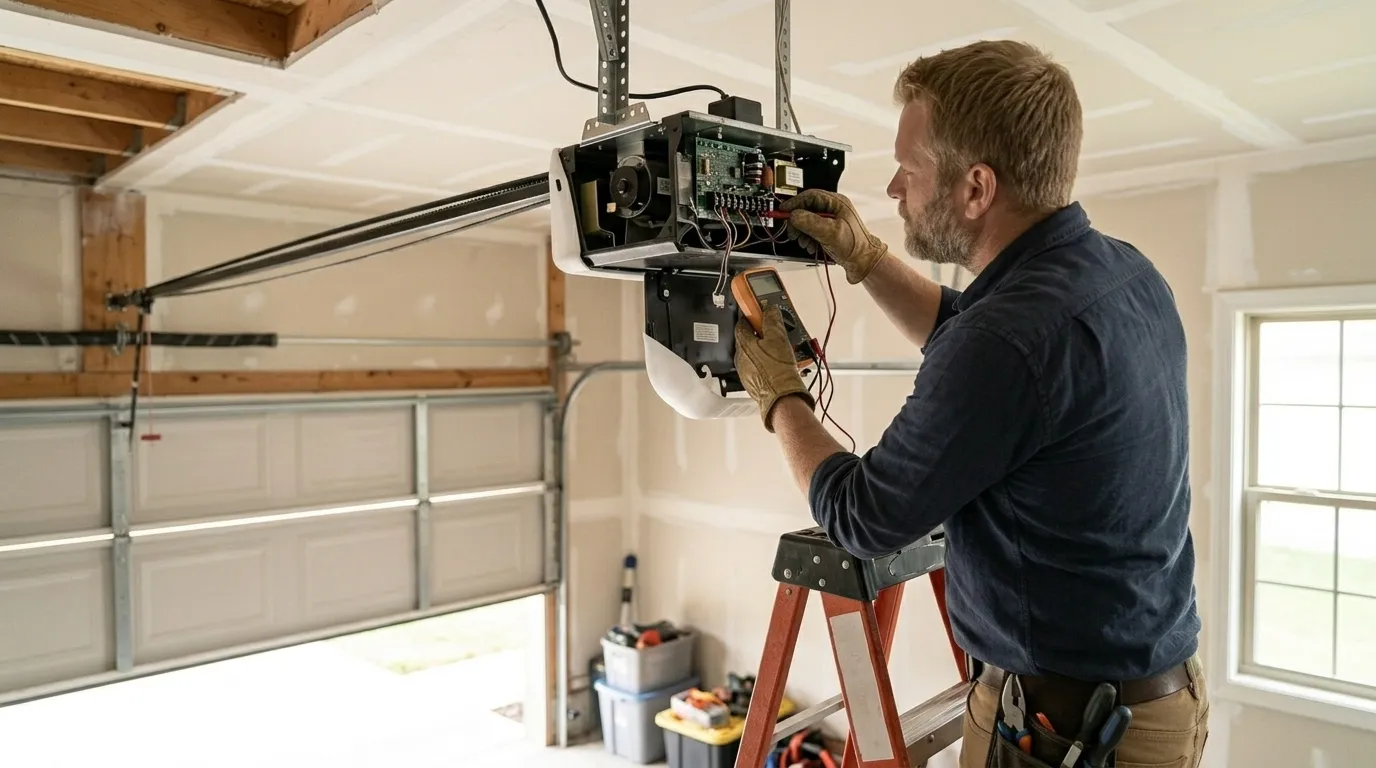
A typical emergency call here is a broken torsion spring, a snapped cable, or a roller that's worn through its bearing and jumped the track. Parts for doors this age are still common - the springs, cables, and rollers aren't specialty items - but the openers paired with them sometimes are. A chain-drive opener from the early 90s can still run fine mechanically while its control board has quietly failed, and that's a different repair than a spring swap.
We carry the common torsion spring sizes and standard hardware on the truck. What we don't carry is every discontinued opener logic board ever made - if yours is one of those, that's a special-order part, and we'll tell you that straight instead of guessing at a same-visit fix.
The fault we see most in Antelope isn't the door - it's the opener quitting on the hottest afternoons. This area sits in a severe-heat climate band, and garage interiors run well past outdoor temperature by mid-afternoon. Opener circuit boards and capacitors from this build era weren't engineered for that kind of sustained heat load, and they fail exactly when you need the door most: closing up before you leave, or opening when you get home.
The second failure, and the one that's less obvious, is the spring itself fatiguing faster than it would in a milder climate. Steel expands and contracts with the heat cycle every single day, and a torsion spring on a door built in the early 90s has been doing that for three decades. What looks like a sudden break on a hot afternoon is usually years of heat cycling catching up all at once, not a random failure.
If your door is groaning, sagging on one side, or the opener clicks without moving the door, that's the spring or the board, and it's worth a call before it fails completely and leaves the door stuck down - or worse, stuck open.
Two things complicate an otherwise straightforward spring or opener repair in a house this age. First, double-wide doors on original track: if the track was never upgraded, the hardware bracing sometimes isn't rated for a same-day drop-in replacement spring, and we have to reinforce the mounting before we touch the spring. Second, steel panel doors from this era without foam-core insulation can warp slightly from years of heat exposure, which throws the door out of square in the track - a symptom that looks like a spring problem but is actually a door problem.
The honest limitation here: if the opener board is the failure and it's a discontinued model, we can't always source the exact replacement board on the truck. In that case the choice is a compatible universal opener swap or waiting on a special-order part, and we'll walk you through both instead of pushing whichever is faster for us.
We also won't tell you a full door replacement is the answer just because the door is thirty-some years old. If the panels are sound and it's a spring or roller problem, we fix the part that's broken and leave the rest of the door alone.
We don't quote a flat number for emergency repair without seeing the door, because a broken cable and a fried opener board are not the same job or the same parts cost. What we can tell you is that the median household income in Antelope runs around $95,102, a bit under the $98,158 median across the wider service area, and that gap doesn't change what a torsion spring costs - parts pricing is parts pricing regardless of the street it's installed on.
What does change the bill is whether the fix is a stock part off the truck or a special-order opener board. Stock parts - springs, cables, rollers, standard hinges - get quoted on the spot once we've looked at the door. A discontinued board that has to be sourced adds a wait and usually a different price bracket, and we'll say so before we order anything, not after.
We're not going to pad an estimate with a full opener replacement when the board swap or a spring job solves it. If replacement genuinely is the cheaper long-term call - say the door is warped badly enough that repairs won't hold - we'll say that too, plainly, and let you decide.
A torsion spring replacement on a standard door is a contained job - get the tension off the old spring safely, wind the new one to the right turns, check the cables and rollers while we're in there. A cable snap or a roller swap is similarly self-contained. Those are the calls that get resolved in a single visit, tools already on the truck.
An opener board failure is the variable one. If it's a common board or we can drop in a compatible universal opener, that's still a same-visit fix. If your unit needs a specific discontinued board, the visit that day is diagnosis and a temporary manual-operation fix so the door still opens and closes safely, and the actual repair happens once the part arrives.
We're not going to promise a number of hours here, because doors don't fail on a schedule and neither does parts availability. What we will say is that we diagnose on the first visit every time, and if a return trip is needed for a part, you'll know that before we leave, not find out three days later when nobody's called you back.
Opener circuit boards and capacitors from the early 1990s weren't built for the sustained heat this area's severe-heat climate produces inside a closed garage. Heat stress on aging electronics is the most common cause of an opener that clicks but doesn't move the door, or stops responding altogether on a hot afternoon.
Not automatically. A steel door from the early 90s with sound, unwarped panels is usually still worth repairing - springs, cables, and rollers are common parts. Replacement makes more sense when the panels themselves have warped from heat exposure or the door is out of square in the track.
We carry common torsion springs and standard hardware for doors of this era. What we don't always carry is a specific discontinued opener control board - those sometimes need to be special-ordered, and we'll tell you that on the first visit instead of guessing.
About 9 miles. We don't quote a fixed arrival time over the phone since that depends on drive time and what's ahead of your call on the board that day, but Antelope calls get folded into the same day's schedule.
Call now or request a free quote - same-day service on most repairs, upfront written pricing.