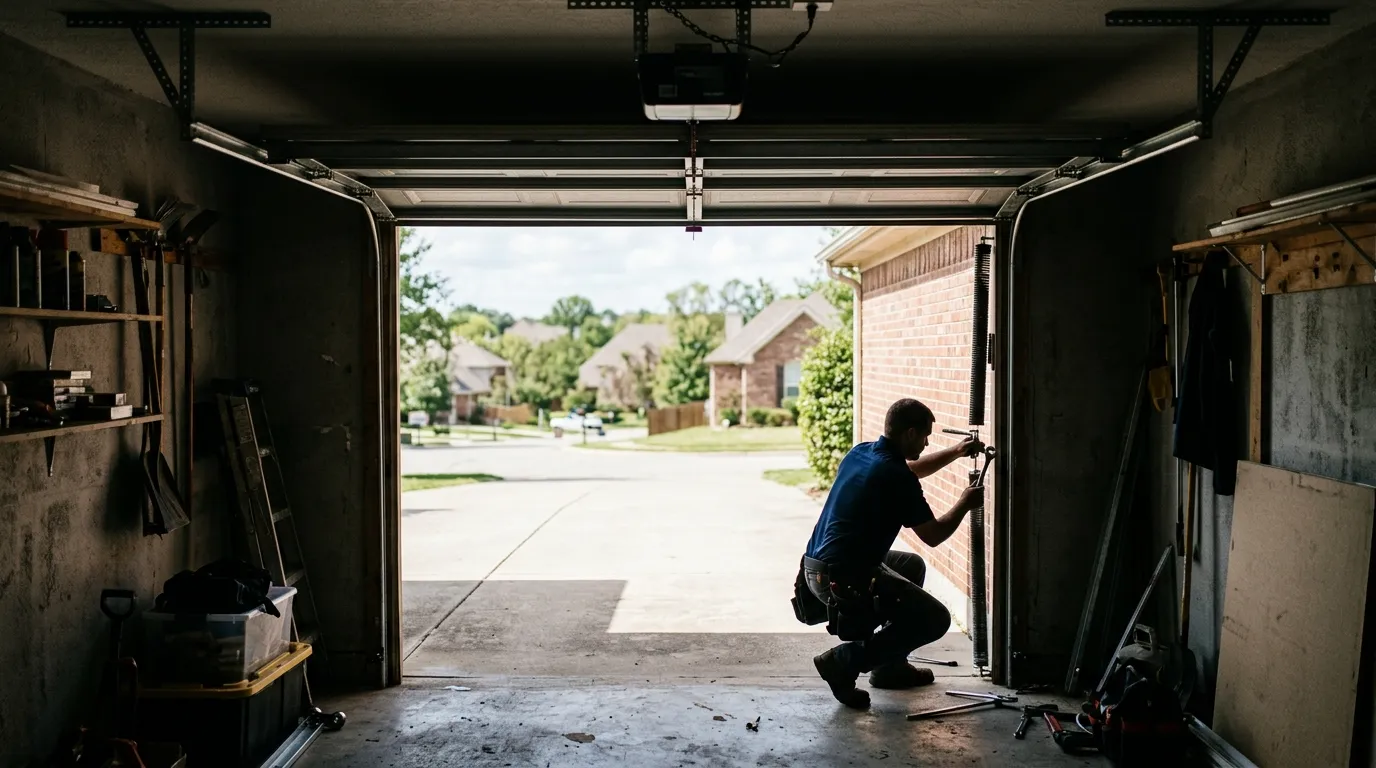
Rocklin, CA · Garage Door Service
Granite Bay's 1980s-era doors and torsion hardware, serviced from five miles away in Rocklin. What breaks here, what it costs, and what a tech actually does on the call.
Granite Bay is five miles from our shop in Rocklin, which is close enough that a same-day call isn't a stretch, but that short drive can be misleading. A five-mile trip means nothing if the tech shows up with the wrong torsion spring size or an opener board that doesn't match what's actually bolted to the header. Most of the trouble on this side of town isn't the drive - it's guessing wrong about the house before the truck leaves.
Granite Bay sits between two other pockets we cover: Whitney Oaks, about two miles northeast, and the corridor along East Roseville Parkway, roughly three miles southeast. Both share a similar build era with the rest of Granite Bay, which is part of why we ask a few questions on the phone before we load parts - a torsion spring sized for a 1990s door doesn't fit a 1987 one cleanly, and a wrong first guess means a second trip.
The honest version: a five-mile radius doesn't buy urgency by itself. It buys us the ability to come back same day if the first fix doesn't hold, which matters more than how fast we got there the first time.
Most houses in Granite Bay went up around 1987, which puts the neighborhood a bit newer than the 1963-2004 spread you'll find across the rest of the service area. That narrower build window means a lot of doors here are running original torsion hardware that's now pushing thirty-five years old, plus first- or second-generation chain-drive openers that were never swapped out because nothing obviously broke.
Heat is the other half of it. Summers here run hot enough, and long enough, to matter for anything with grease or a circuit board in it. Roller bearings packed with lubricant don't hold up as long as the packaging promises once they've baked through enough Julys. Opener logic boards fail more from heat-cycling in a hot garage than from age alone, and galvanized track can expand just enough on a 100-degree afternoon to bind a roller that ran fine in February.
Put those two things together - original-era torsion springs and heat-stressed openers - and you get the two most common calls out here: a spring that finally gives out on a door that's opened the same way for three decades, and an opener that starts working intermittently every summer and dies completely by August.
Some of it, yes. Tightening a loose hinge, cleaning and lubricating rollers, replacing weatherstripping - a homeowner with basic tools can do all of that safely on a Saturday.
Torsion spring work is not that category. A torsion spring on a residential door holds enough stored energy to break a wrist or worse if the winding bars slip, and on a house with 1980s-era hardware, the spring may not match anything sold at a hardware store off the shelf. Opener circuit board swaps are usually fine for a confident DIYer, but only if the board is actually the problem and not a symptom of a failing sensor or a binding track upstream of it.
The honest limit here: if the door won't move, or moves and reverses on its own, stop. That's almost always a spring, cable, or sensor alignment issue, and diagnosing it wrong before calling someone costs more than the service call would have.
We don't post a price list for Granite Bay specifically, because the honest answer depends on what's actually wrong - a spring replacement, an opener swap, and a full track realignment aren't the same job and don't cost the same. What we can say is that Granite Bay's median household income runs well above the wider service area's figure of $98,158, and in practice that shows up as a preference for full replacement over patch repairs once a door is past its mid-life. Owners here are more likely to replace a struggling 1980s door outright than keep nursing a corroded track or a spring nobody stocks anymore.
We won't quote a number over the phone before seeing the door. Torsion spring sizing, drum type, and cable gauge all vary enough by installation date that a phone estimate is a guess dressed up as a quote, and we'd rather tell you that up front than give you a number we can't hold to.
A straightforward torsion spring swap on a single door usually runs under two hours once the tech is on site, parts in hand. Where it slows down is sourcing - original 1987-era spring wire diameters and drum sizes aren't always something a truck carries as standard stock, and if the door has been modified once already (a wider opener, a heavier insulated panel added later), matching the spring to the current setup takes an extra measurement pass before ordering.
Opener replacement is more predictable: an hour to remove the old unit, mount and wire the new one, and set travel limits and force settings correctly - the force setting matters more in a hot garage, since heat-expanded track can make an opener strain against resistance it wouldn't fight in cooler months.
We won't promise a same-day repair sight unseen. If a part needs to be special-ordered for an older Granite Bay door, that's a day or two we can't shortcut, and we'd rather tell you that than leave you waiting on a truck that isn't coming.
The call we get most from this part of town starts the same way: the door opens fine but reverses partway down, or it groans and strains on the way up before finally moving. On a house built around the mid-1980s, that's almost always a torsion spring that's lost tension after decades of summer heat cycling, not a broken cable or a bad sensor - though we check both before we touch the spring.
A second, quieter version of the same problem: the opener runs, the door doesn't respond, and nothing on the wall panel does anything either. That's usually a heat-fatigued circuit board on an opener that's outlasted its expected life by a decade or more, common on original units from this build era that were never replaced because the door itself never gave anyone a reason to call.
Either symptom is worth a call before it becomes a door stuck halfway open on a 100-degree day with a car underneath it.
It's about five miles from our Rocklin location. That's close enough that we can usually work Granite Bay into the same day's route, but scheduling still depends on parts - if your door needs an older torsion spring size we don't carry as standard stock, that adds a day or two regardless of the drive.
Most homes here went up around 1987, so a lot of the original torsion springs and early-generation openers are still in place decades later. Newer subdivisions built after 2000 tend to have newer hardware still under its expected life, which is why the failure pattern looks different even a few miles apart.
Yes. Grease-packed bearings and rollers break down faster after repeated hot summers, and opener circuit boards fail more from heat-cycling in an unventilated garage than from age by itself. It's a slower failure than a broken cable, which is why it often shows up as intermittent trouble before it fails completely.
Not honestly, no. Spring sizing, drum type, and cable gauge vary enough between individual installations that a phone quote would be a guess. We'll give you a firm number after looking at the actual door and hardware.
Call now or request a free quote - same-day service on most repairs, upfront written pricing.